Triad of Secret Societies


As a result of research and as a Sinophile, it's become quite obvious that Rohmer's authentic knowledge of the orient was painfully lacking. Clearly, he was not conversationally fluent in Chinese. If Rohmer consulted persons fluent in the language, it's a safe bet they spoke the Cantonese dialect. Whatever resources he may have referenced, they certainly utilized the old Wade–Giles system of transcription, which is to be expected considering that period in history. Furthermore, Rohmer frequently reveals a lack of concern for differences and distinctions between ethnic groups, their nations, histories, cultures, customs, and religions.

Most interestingly, Rohmer's lack of precise and genuine knowledge of his subject matter is openly revealed through his lead characters. The heroes (and readers) constantly ask precise questions. Invariably the heroes receive vague, incomplete, and incorrect answers. Worse yet, readers often receive vague, incomplete, and incorrect answers.

This is a clear indication that, frequently, Rohmer possessed only a vague intuition or incomplete idea of where he intended to take the plot. At times, it seems as though he simply sat down and started writing. Some element would strike his fancy and he'd toss it into the mix without any forethought, purpose, or plan for future development. Considering many of Rohmer's stories were serialized before they were compiled and published as novels, these observations may not be far from fact.

Mind you, I'm not expressing dissatisfaction. I'm simply making specific observations, because these issues create some interesting obstacles concerning serious interpretation and analysis. These issues certainly complicate any attempt to determine author intent. Inevitably, this gives rise to differences concerning interpretation and analysis.

With that said, there seems to be a bit of confusion concerning certain groups and organizations, specifically the Sublime order of the White Peacock, the Council of Seven, the Si-Fan, and the Seven Elite Assassins of the Si-Fan. Both Rohmer and researchers tend to refer to these groups nearly indiscriminately and interchangeably. Let's sort it out, shall we?

I suggest the Council of Seven, the Sublime Order of the White Peacock, and the Si-Fan are three separate and distinct individual organizations with shared members and objectives. In support of these claims, I offer the following evidence:

1911
"To Mr. Commissioner NAYLAND SMITH and Dr. PETRIE—
Greeting! I am recalled home by One who may not be denied. In much that I came to do I have failed. Much that I have done I would undo; some little I have undone. Out of fire I came—the smoldering fire of a thing one day to be a consuming flame; in fire I go. Seek not my ashes. I am the lord of the fires! Farewell.FU-MANCHU."

[ The Insidious Dr. Fu Manchu ]
Claims:
  • Fu Manchu claims "One who may not be denied" called him home.
Assumption:
  • Reading this, one would assume the "One who may not be denied" is a superior member of some unidentified organization of which Fu Manchu is a member. That is certainly a reasonable assumption. Nevertheless, it is an assumption.
Interesting that Fu Manchu should state "home" not "to China". Could it be a wife, family member, or personal concern calling him home, rather than a superior business associate ordering him to China?

1913
"You come at an opportune time, Mr. Commissioner Nayland Smith, and Dr. Petrie; at a time when the greatest man in China flatters me with a visit. In my absence from home, a tremendous honor has been conferred upon me, and, in the hour of this supreme honor, dishonor and calamity have befallen! For my services to China—the New China, the China of the future—I have been admitted by the Sublime Prince to the Sacred Order of the White Peacock." -- Fu Manchu speaking to Nayland Smith
[ The Return of Dr. Fu Manchu ]
Facts:
  • The events detailed in "The Return of Dr. Fu Manchu" take place after the events detailed in "The Insidious Dr. Fu Manchu".
Claims:
  • Fu Manchu claims the greatest man in China is visiting him.
  • Fu Manchu claims he is presently a member of the Sacred Order of the White Peacock. 
  • Fu Manchu claims the Sublime Prince admitted him to the Sacred Order in Fu Manchu's absence from home.
Assumption:
  • Presumably, the greatest man in China is visiting Fu Manchu to deliver the news of Fu Manchu's acceptance into the Order.
Therefore:
  • It's not likely the Sublime Prince or some superior member of the Sacred Order had called Fu Manchu home two years past. It's possible, but not likely. 
I suggest:
  • It's far more likely a member from the Council of Seven called Fu Manchu home.
1913
"I always knew and you always knew," interrupted Smith in his short, decisive manner, "that Fu-Manchu, genius that he was, remained nevertheless the servant of another or others. He was not the head of that organization which dealt in wholesale murder, which aimed at upsetting the balance of the world. I even knew the name of one, a certain mandarin, and member of the Sublime Order of the White Peacock, who was his immediate superior. I had never dared to guess at the identity of what I may term the Head Center." --Nayland Smith speaking to Petrie
[ The Hand of Fu Manchu ]
Claims:
  • Smith claims Fu Manchu was the servant of another and not the head of some unidentified organization.
  • Smith claims The Sacred Order of the White Peacock is now the Sublime Order of the White Peacock.
  • Smith claims Smith claims a certain unnamed mandarin and member of the Sublime Order is Fu Manchu's immediate superior.
  • Smith claims he dares not speculate on the identity of the big boss. 
Therefore:
  • Fu Manchu is or was a subordinate to the authority of two separate organizations
  • Fu Manchu had at least one superior in some unidentified organization.
  • Fu Manchu had at least two superiors in the Sublime Order.
I suggest:
  • The mandarin Ki-Ming and the Sublime Prince are Fu Manchu's superiors in the Sublime Order. 
  • The Sublime Order is under the authority of the Council of Seven.
  • As a member of the Sublime Order, Fu Manchu is subordinate to the authority of Ki-Ming, the Sublime Prince, and the Council of Seven. 
1913
"I have selected you, rather than Mr. Commissioner Nayland Smith," continued the mandarin, "as the recipient of those secrets which I am about to impart, for the reason that your friend might possibly be acquainted with my appearance. I will confess there was a time when I must have regarded you with animosity, as one who sought the destruction of the most ancient and potent organization in the world — the Si-Fan." 
As he uttered the words he raised his right hand and touched his forehead, his mouth, and finally his breast — a gesture reminiscent of that employed by Moslems. 
"But my first task is to assure you," he resumed, "that the activities of that Order are in no way inimical to yourself, your country or your King. The extensive ramifications of the Order have recently been employed by a certain Dr. Fu-Manchu for his own ends, and, since he was (I admit it) a high official, a schism has been created in our ranks. Exactly a month ago, sentence of death was passed upon him by the Sublime Prince, and since I myself must return immediately to China, I look to Mr. Nayland Smith to carry out that sentence."
"The Si-Fan," he added, repeating the gesture with his hand, "disown Dr. Fu-Manchu and his servants; do with them what you will. In this envelope"—he held up a sealed package—"is information which should prove helpful to Mr. Smith. I have now a request to make. You were conveyed here in the garments which your wore at the time that my servants called upon you." --Ki-Ming speaking to Petrie.
[ The Hand of Fu Manchu ]
"The story of Fu-Manchu, and of the organization called the Si-Fan which he employed as a means to further his own vast projects, is almost told." --Petrie
[ The Hand of Fu Manchu ]
Claims:
  • Petrie claims Ki-Ming was a mandarin in 1915.
  • Ki-Ming claims the Si-Fan was the most ancient and potent organization in the world.
  • Ki-Ming claims Fu Manchu was a high official in an unidentified organization prior to this encounter in 1913.
  • Ki-Ming claims Fu Manchu employed the Si-Fan for his own ends prior to this encounter in 1913. 
  • Ki-Ming claims a schism has recently developed in the ranks of an unidentified organization.
  • Ki-Ming claims the Sublime Prince passed a death sentence on Fu Manchu one month ago.
  • Ki-Ming claims the Si-Fan presently disown Fu Manchu.
Inferences:
  • Ki-Ming's actions suggest that he follows the Muslim faith. While there were Chinese practicing the Muslim faith in China at this time, Ki-Ming is described as wearing a diamond earring. It is not allowed for Muslim men to wear earrings. Furthermore, Ki-Ming is not a Muslim name. 
  • Ki-Ming's words suggest that he and Fu Manchu are both members of an unidentified organization.
I suggest:
  • Ki-Ming is a mandarin in 1915.
  • Fu Manchu is a high official the Si-Fan in 1913. In fact, Fu Manchu has been the Dragon Head of the Si-Fan nearly since it's inception.
  • Ki-Ming and Fu Manchu are both members of the Sublime Order.
  • Fu Manchu has covertly employed the Si-Fan to his own ends since 1899.
  • A schism has recently developed in the ranks the Sublime Order.
  • Resultantly, the Sublime Prince passed a death sentence on Fu Manchu.
  • Ki-Ming is attempting to seize control of the Si-Fan from Fu Manchu.
  • Ki-Ming's statement about the Si-Fan is utter propaganda.
Rationale:
As previously noted, Rohmer possessed little expertise on such subjects. Rohmer often confused and intermingled details from various ethnic groups, nations, histories, cultures, customs, and religions. Additionally, as previously noted, Rohmer possessed no complete, clear, or distinct picture of these organizations his own mind. Rohmer seemingly refers to these groups nearly haphazardly, indiscriminately, and interchangeably.

When it comes to China, frequently, it can be difficult to discern fact and history from legend and myth. Moreover, Chinese are possessed of a cultural predilection for claiming things are older than they genuinely are.

According to research, the Si-Fan formed in 1899. However, the Si-Fan might claim lineage from the Heaven and Earth Society (1761), The Five Elders of Shaolin (1641), or even the White Lotus Society (1330). After members from the Thuggee Cult of Kali join the ranks of Si-Fan (1903), the organization professes to be older than Buddha (480 - 400 BCE).

Either Ki-Ming is knowingly and deceptively exaggerating the age and status of the Si-Fan or Ki-Ming has been deceived about these matters by Fu Manchu or the Si-Fan themselves. Considering that Fu Manchu has previously attempted to deceive the Si-Fan, the Council of Seven, the Sublime Order with a claim that his daughter, Fah Lo Suee, was the incarnation of a legendary Assyrian - Persian - Hindustani - Tibetan - Mongolian messianic figure destined to rule the world, this argument is not without merit.

1915
"... When you visit the laboratory of our chief chemist in Kiangsu you will be shown the whole of the armory of the Sublime Order... The common black scorpion of Southern India," he said softly. "Its venom is the basis of the priceless formula, F. Katalepsis, upon which the structure of our Sublime Order rests, Dr. Stuart; hence the adoption of a scorpion as our device." --Fo-Hi speaking to Stuart.
[ The Golden Scorpion ]
Claims:
  • Fo-Hi claims Fu Manchu was the chief chemist for the Sublime Order in 1915.
  • Fo-Hi claims Fu Manchu's laboratory was in Kiangsu in 1915.
  • Fo-Hi claims Fu Manchu's F. Katalepsis is highly prized by Sublime Order in 1915. 
  • Fo-Hi claims Golden Scorpion tokens were devices of the Sublime Order in 1915.
1915
"I do not know that. If he is alive, he is in China--at some secret palace in the province of Ho-Nan, which is the headquarters of what is called the 'Sublime Order.' I have never been there, but there are Europeans there, as well as Orientals." --Miska speaking to Stuart
[ The Golden Scorpion ]
Claims:
  • Miska claims the Sublime Order was headquartered in Honan as of 1915.
  • Miska claims Europeans and Orientals are at the headquarters in Honan.
1915
"Let me go on from the time when I saw Fo-Hi in Cairo. He told me that I was a member of an organization dating back to remote antiquity which was destined to rule all the races of mankind--the Celestial age he called their coming triumph. Something which they had lacked in order to achieve success had been supplied by the dreadful man who had entered the room and expressed his approval of me." --Miska speaking to Stuart
[ The Golden Scorpion ]
Claims:
  • Miska claims the Sublime Order dates back to remote antiquity, according to Fo-Hi.
  • Miska claims the Sublime Order is destined to rule all the races of mankind, according to Fo-Hi.
  • Miska claims that Fu Manchu supplied the Sublime Order with something they had lacked to achieve success, according to Fo-Hi.
"For many years they had been at work in Europe, secretly, as well as in the East. I understood that they had acquired a quantity of valuable information of some kind by means of a system of opium-houses situated in the principal capitals of the world and directed by Fo-Hi and a number of Chinese assistants. Fo-Hi had remained in China most of the time, but had paid occasional visits to Europe. The other man--the monster with the black skull cap--had been responsible for the conduct of the European enterprises." --Miska speaking to Stuart
[ The Golden Scorpion ]
Claims:
  • Miska claims the Sublime Order operates a system of opium-houses situated in the principal capitals of the world, according to Fo-Hi.
  • Miska claims this system of opium-houses was directed by Fo-Hi and a number of Chinese assistants.
  • Miska claims Fu Manchu was responsible for the conduct of the Sublime Order's European enterprises.
I suggest:
  • Fo-Hi was the director of the opium den operated near the Rue St. Claude in Paris by a certain Madame Jean and her assistant Chinaman Sen in January 1910. [ The Yellow Claw ]
  • Fo-Hi was the director of the opium den referred to as the Cave of the Golden Dragon operated in London by the man known as Mr. King and his assistant Ho-Pin in January 1910. [ The Yellow Claw ] 

On the Origins of the Sublime Order of the White Peacock

In the Fu Manchu novels by Sax Rohmer, the Sublime Order of the White Peacock is a secret society that serves as one of the primary antagonistic organizations opposing the protagonist, Sir Denis Nayland Smith. The organization takes its name from the white peacock, which is a symbol of immortality in some Asian cultures.

Historical References
According to Daraul, the Order of the Peacock Angel is a Yazidi-influenced secret society. The group subscribes to a belief in a power governing human affairs, symbolized by a peacock. Recruits are instructed through a series of mental and physical exercises intended to place the experience of emotion under control of the will.

In 1913, a version of the cult was brought to Britain by a Syrian whose name is only known to initiates. Daraul claims to have encountered members of this organization in the suburbs of London and attended their rituals. Daraul described a ceremony where robed members engaged in an ecstatic dance in the presence of a large statue of a peacock.

Membership grew to encompass "several hundred members throughout Britain" and "three lodges in the United States". Some members were said to keep live peacocks. As a sign of identification, the right hand is placed, with the fingers spread out (perhaps to represent the tail of the peacock) on the left breast, just above the heart. Daraul appears to be the only source of information for the existence of this group.
[ Secret Societies Yesterday and Today by Arkon Daraul. Subsequently reissued as: A History of Secret Societies. ]

Yazidis are monotheists. They believe God created the world and entrusted it into the care of seven Holy Beings, called the Seven Mysteries. Preeminent among these is Tawûsê Melek, the Peacock Angel.

Tawûsê Melek, or Melek Taus in English publications, is uncontroversially translated as "peacock angel". In art and sculpture, Tawûsê Melek is depicted as a peacock. Interestingly, peacocks are not native to the lands where Tawûsê Melek is worshiped.

However to early Christians, the peacock represented immortality. According to folk belief, its flesh does not decay after death. This symbolism passed into Yazidi beliefs. Consequently, peacock imagery adorns Yazidi shrines, gateways, graves, and houses of worship.

Peafowl include three species:
  • Pavo cristatus - the blue peafoul of India and Sri Lanka.
  • Pavo muticus - the green peafowl of Myanmar, Indonesia, and Java.
  • Afropavo congensis - the mbulu peafowl of the Congo Basin, Africa.
White (leucistic) Indian Peafoul
Occasionally, peafowl appear with white plumage. Although albino peafowl do exist, this is quite rare. Nearly all white peafowl are not, in fact, albinos.

White peafoul possess a genetic mutation called leucism. This causes an overall reduction in pigment. In peafowl, this results in a complete lack of plumage pigment. However, leucism leaves peafoul with blue eyes.

By contrast, true albino peafowl feature a complete lack of melanin. This results in white plumage. However, albino peafoul possess red or pink eyes. Furthermore, leucistic peachicks are born yellow and become fully white as they mature.

Chinese Peafoul
At one time, green peafowl might be found in southwestern China. However, it's not likely they were indigenous. It's far more likely they originally migrated from Burma. While the phoenix prominently appears in Chinese art, myth, and religion, the peacock does not.

Conclusions

I suggest:
  • The Council of Seven oversees the operations of an international confederation of powerful secret societies.
  • The Council of Seven provides top-tier leadership and authority for its member secret societies.
  • The Council of Seven functions as a sort of United Nations for secret societies.

  • The Sublime Order of the White Peacock is a powerful secret society.
  • Members of this organization embrace an odd combination of religious traditions from Assyria, Persia, Hindustan, Tibet, and Mongolia.
  • While the organization was headquartered in Honan in 1915, it was not a Chinese organization, at least not in origin.

  • The Si-Fan began as a patriotic organization and desired to restore China to the former glory of the Ming Dynasty. 
  • Leadership and control of this organization was quickly seized by Fu Manchu. 
  • The Si-Fan was, is, and forever shall be, Fu Manchu's personal tool - more or less.
At least, that's how these organizations are characterized in their respective early years. Over time, these organizations form complex and intricate relationships. Consequently, their original natures and functions evolve, as does their membership.

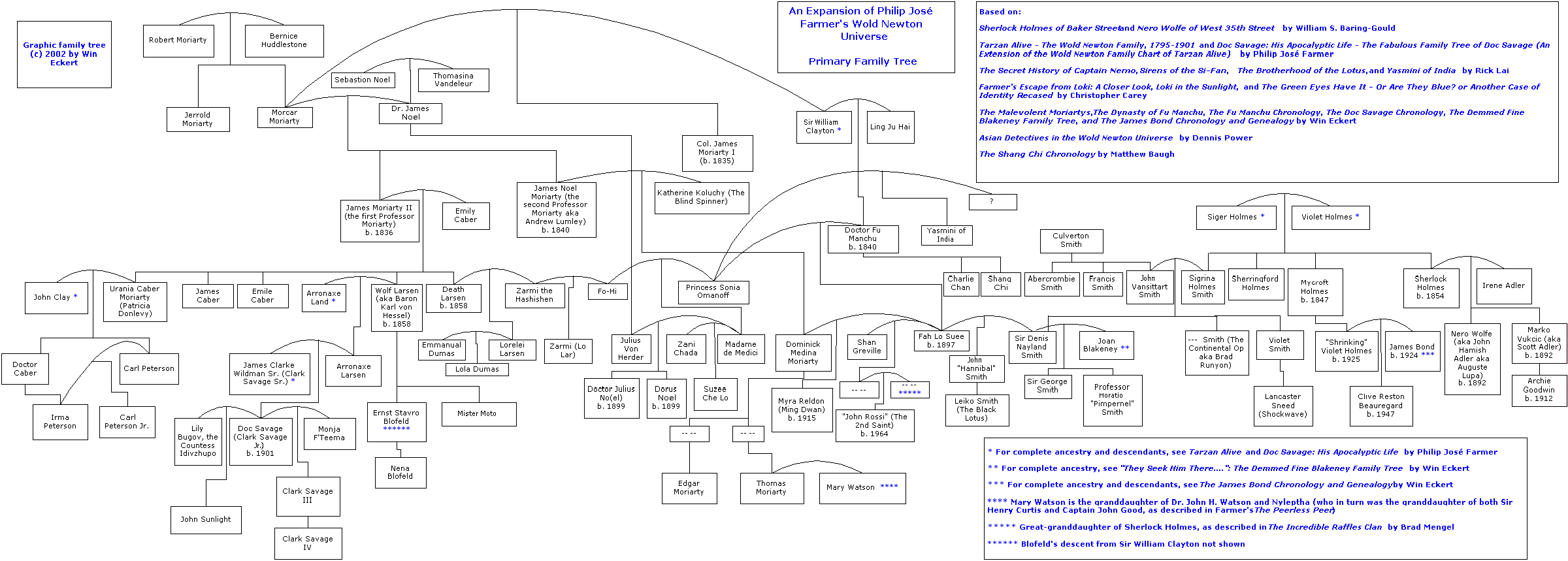
The Family Tree

Extremely fascinating research has been done on the subject of Shang-Chi's genealogy by Win Scott Eckert. Interestingly, we see the Nayland SmithSherlock Holmes - Lancaster Sneed - Clive RestonJames Bond connections.

It should be noted, this parentage makes Fu Manchu the half-brother of Professor Moriarty and a cousin of Tarzan. However, Farmer's identification of General Sir William Clayton as Fu Manchu's father - and as father of Moriarty, for that matter - is not universally accepted. Some scholars prefer to follow the hints in Rohmer's books that Fu Manchu is actually an ancient Egyptian pharaoh.Source Link


'Nuff said!

Fu Manchu's Parentage


Sax Rohmer, the creator of Fu Manchu, was quite vague about the circumstances surrounding the birth of Fu Manchu. Only a mere hint was suggested by Rohmer. On this particular subject, Rohmer provided a bit of myth, legend, and lore but precious little fact.
"... There is a superstition in some parts of China according to which, under certain peculiar conditions (one of which is proximity to a deserted burial-ground) an evil spirit of incredible age may enter unto the body of a new-born infant. All my efforts thus far have not availed me to trace the genealogy of the man called Dr. Fu-Manchu. Even Karamaneh cannot help me in this. But I have sometimes thought that he was a member of a certain very old Kiangsu family - and that the peculiar conditions I have mentioned prevailed at his birth!" -- James Weymouth, brother of Inspector Weymouth, speaking to Smith, Petrie, and Kâramanéh.
[ The Insidious Fu Manchu by Sax Rohmer. ]

In fact, Rohmer was deliberately and intentionally vague concerning much of Fu Manchu's past. This only makes sense. After all, Fu Manchu was designed to be a mysterious character. His past is supposed to be shrouded in mystery. While it makes for an interesting character and compelling reading, it certainly doesn't assist our quest for answers.

As I've argued in "Triad of Secret Societies", frequently, Rohmer possessed only a vague intuition or incomplete idea of where he intended to take the plot. At times, it seems as though he simply sat down and started writing. Some element would strike his fancy and he'd toss it into the mix without any forethought, purpose, or plan for future development. Considering many of Rohmer's stories were serialized before they were compiled and published as novels, these observations may not be far from fact.

Far too often, Rohmer presents misinformation to the reader. This is evidenced by many of Smith's incorrect explanations, assumptions, and half-baked answers to questions. This lack of clarity is bound to create some confusion.

These issues create some interesting obstacles concerning serious interpretation and analysis. These issues certainly complicate any attempt to determine author intent. Inevitably, this gives rise to differences concerning interpretation and analysis.

As far as James Weymouth's statements are concerned, I'm inclined to dismiss such conjecture as silly superstitious nonsense, disinformation, and utter propaganda from an insignificant third-tier character. It seems this is a perfect example of some element striking Rohmer's fancy. He tossed it into the mix without any forethought or plan for future development.

With that out of the way, we'll explore the remaining information. Unfortunately, a search for answers reveals multiple claims about the circumstances surrounding the birth of Fu Manchu. Furthermore, each account offers conflicting details.

In "Doc Savage: His Apocalyptic Life" and in later editions of "Tarzan Alive", Philip José Farmer draws on theories that Fu Manchu was based on Hanoi Shan, a villain featured in the works of Harry Ashton-Wolfe. However, research by Matthew Baugh and Rick Lai conclusively debunk any theory that Fu Manchu was Hanoi Shan or that crimes attributed to Hanoi Shan were committed by Fu Manchu. This gives pause to examine the subject a bit more carefully and thoroughly. In so doing, it would be most prudent to disregard references to Hanoi and Annam.

Bear in mind, the information provided by Farmer is not entirely accurate. No disrespect intended to Mr. Farmer or his work. It's imperative to understand, by comparison, he had fewer sources and limited access to information at the time he composed the works in question. Today, we have many more sources and much greater access to information. With that said, on with our investigation and as Farmer himself suggested "let the reader decide".

Philip José Farmer claims:
  • While in Southeast Asia during the Opium War (1839-1842), Sir William Clayton went to Hanoi.
  • At this time, this part of the Southeast was called Annam and was an empire covering the present states of North and South Vietnam. Its ruler was killing off all the native Christians he could unearth.
  • Sir William Clayton had been sent to investigate the disappearance of a wealthy half-Chinese merchant who was a British citizen.
  • Sir William succeeded in his mission, rescuing the merchant and his family including the beautiful green-eyed daughter Ling Ju Hai.
  • Ling Ju Hai was descended from Manchurian mandarins on her mother's side.
  • Ling Ju Hai's father was part-Scotch.
  • Sir William's memoirs detail the thrilling escape and his brief-but-passionate affair with Ling Ju Hai.
  • When Ling Ju Hai's father discovered that she was pregnant, he spirited her away to China and sent assassins after Sir William.
  • Sir William Clayton killed them all in a battle on a junk which could have been a scene from the Douglas Fairbanks movie The Black Pirate.
  • Sir William tried to track Ling Ju Hai but gave up when he heard that she had died while giving birth. As it turned out, this was a lie originated by the father.
  • Sir William married the daughter of a Dutch merchant on the rebound and then was ordered to South Africa.
  • Later, Ling Ju and her son returned with her father to Hanoi.
  • It cannot be proven that Fu Manchu was indeed Sir William Clayton's son.
  • Sir William had dark-gray eyes and Ling Ju Hai had brilliant green eyes.
  • Some of Sir William's ancestors had green eyes (notably his mother). And two of Sir William's sons by other women -- Professor Moriarty and John (Colonel) Clay,
[ Doc Savage: His Apocalyptic Life by Philip José Farmer. ]

The Wold Newton Resource Wiki claims:
  • Fu Manchu as the illegitimate son of General Sir William Clayton, younger son of the 3rd Duke of Greystoke who had been a witness at the Wold Newton Meteorite strike.
  • William Clayton had been in Hanoi during the Opium Wars,
  • William Clayton was sent to locate a wealthy part-Scottish part-Chinese merchant who had gone missing.
  • William Clayton located and rescued the merchant and his beautiful daughter, Ling Ju Hai.
  • When Ling Ju Hai's father discovered that William Clayton had embarked on an affair with her, he sent her away to China.
  • Ling Ju Hai gave birth to a son, later known as Fu Manchu.

Rick Lai claims:
  • Fu Manchu's mother was Ling Ju Hai.
  • Ling Ju Hai was the daughter of a prominent Chinese merchant and a Manchurian woman.
  • During the Opium War, Ling Ju Hai and her father were faced with execution by the ruler of Annam.
  • They were rescued by an intrepid British adventurer, Sir William Clayton.
  • Ling Ju Hai and William Clayton had an affair which resulted in the birth of the man known as Fu Manchu.
  • When Ling Ju Hai's father learned that she was pregnant, he arranged for her to be spirited away from William Clayton.
  • The outraged merchant then dispatched assassins to murder William Clayton. All of these pursuers were defeated by William Clayton in a spectacular battle on a Chinese junk.
  • For several years, William Clayton searched vainly for Ling Ju Hai.
  • In 1845, William Clayton gave up his search and married Maida van Kortrijn, the daughter of a Dutch merchant.

Rick Lai also claims:
  • Fu Manchu was the illegitimate son of Sir William Clayton and Ling Ju Hai.
  • Ling Ju Hai was the green-eyed daughter of a half-Chinese merchant and a Manchurian princess.
  • William Clayton met Ling Ju Hai when he was sent to rescue her father from persecution by the ruler of Annam.
  • In his rescue mission, William Clayton enlisted the assistance of Dirk Struan.
  • Ling Ju Hai slept with both William Clayton and Dirk Struan, but the father of her son was the latter.
  • From Dirk Struan, Fu Manchu not only inherited green eyes, but also a strong belief in maintaining one's word and a vindictive disposition.
  • Ling Ju Hai lied about the identity of her son's father in order to protect Dirk Struan from her father's retribution.
  • Since the father of Ling Ju Hai sent assassins after him, William Clayton mistakenly believed that he had impregnated her.
  • Since Struan also fathered a half-Chinese son, Gordon Chen, in Tai-Pan, the real Dr. Fo-Lan must also have been another of the merchant's illegitimate children.
  • Fu Manchu, Gordon Chen, and Fo-Lan shared the same father, but had different mothers.

Dennis E. Power claims:
  • Ling Ju Hai was the daughter of Dirk Struan.
  • Ling Ju Hai was abducted.
  • Dirk Struan enlisted the assistance of William Clayton.
  • William Clayton and Dirk Struan rescued Ling Ju Hai.
  • William Clayton and Ling Ju Hai had an affair.
  • Tyler Brock dispatched assassins to murder William Clayton in a scheme to blame Dirk Struan for William Clayton's death.
  • Ling Ju Hai was sent away to Hainan by her father, Dirk Struan.
  • Ling Ju Hai married a man named Shan.
  • Ling Ju Hai gave birth to twins, Shan Ming Fu (Fu Manchu) and Shan Lan Fo (Fo-Lan).

Very well then, let's see if we can resolve the discrepancies between these numerous claims.

Undisputed claims:
  • Ling Ju Hai's family name was obviously Ling.
  • Ling Ju Hai's mother descended from Manchurian mandarins.
Mandarin:
  1. a member of any of the nine ranks of public officials, each distinguished by a particular kind of button worn on the cap.
  2. an influential or powerful government official or bureaucrat.
  3. a member of an elite or powerful group or class, as in intellectual or cultural milieus.
Manchurian:
  1. of or relating to Manchuria or its inhabitants.
  2. a native or inhabitant of Manchuria.
Therefore:
  • At least one of Ling Ju Hai's parents was ethnically Han Chinese.
  • Ling Ju Hai's mother descended from Manchurian mandarins.
I suggest:
  • Ling Ju Hai's mother's name was Ling.
  • Ling Ju Hai's mother was ethnically Han Chinese.
  • Ling Ju Hai's ancestors served as mandarins in Manchuria.
Undisputed claims:
  • Ling Ju Hai's father was part-Scotch.
  • Dirk Struan was ethnically scottish and was born in Scotland.
  • Ling Ju Hai's father was a British citizen.
  • Dirk Struan was a British citizen.
  • Ling Ju Hai's father was a wealthy merchant.
  • Dirk Struan was a wealthy merchant.
I suggest:
  • Ling Ju Hai's father was Dirk Struan.
Farmer's claim that Ling Ju Hai's father was half-Chinese is easily explained.

Chinese:
  1. a native or inhabitant of China.
  2. a person of ethnically Han Chinese ancestry.
  3. of, relating to, or characteristic of China, its people, customs, culture, or their languages.
Dirk Struan was not ethnically Han Chinese. Nor was he a native. However, he was an inhabitant of Canton, Macau, and Hong Kong.

Furthermore, Dirk Struan embraced cultural integration of East and West. While Dirk Struan discarded much of what he disliked of both Chinese and European society, he fused all that he did admire into a new way of life. Much of his thinking, speech, mannerisms, behaviors, and customs were influenced by Chinese culture. Culturally speaking, Dirk Struan was half-Chinese. In fact, Jin Qua claims as much in "Tai-Pan".

Undisputed claims:
  • William Clayton was in Southeast Asia during the Opium Wars.
  • Ling Ju Hai required rescuing by William Clayton.
  • Someone conducted an affair with Ling Ju Hai.
  • Someone dispatched assassins to murder William Clayton.
I suggest:
  • Ling Ju Hai required rescuing.
  • William Clayton rescued her.
  • William Clayton and Ling Ju Hai had an affair.
  • Although someone sent assassins to murder William Clayton, the cause may or may not be related to this particular adventure.
Now, one might question why Ling Ju Hai or Dirk Struan's adventure with her and William Clayton are not mentioned in Clavell's novels.

Consider the possibility that, perhaps, Clavell was not aware of these events. After all, Clavell researched information for "Tai-Pan" in Hong Kong for only one year. Also consider, the events detailed in "Tai-Pan" primarily occurred between January 26, 1841 and July 21, 1841. Only select details of Dirk Struan's backstory are scattered throughout the narrative.

Neither Ling Ju Hai or Dirk Struan's adventure with her and William Clayton have any direct bearing on or significance to the events of this time frame. The same holds true for Clavell's subsequent novels "Gai-Jin" and "Noble House". Therefore, it's logical that Ling Ju Hai or her rescue by Dirk Struan and William Clayton not be mentioned.

The Pharaoh Seti I Connection
Theories that Fu Manchu was actually an ancient Egyptian pharaoh are complete nonsense. Fu Manchu was, is, and always shall be the "Yellow Peril Incarnate"! Therefore, Fu Manchu must be ethnically Han Chinese.

Modern Egyptians are of African and Middle Eastern ethnic descent. The original inhabitants of Egypt were most likely predominantly of African ethnicity. They enslaved persons from the Hebrew tribes. Subsequently, these two groups interbred.

As I've argued in "Triad of Secret Societies", Rohmer frequently reveals a lack of concern for differences and distinctions between ethnic groups, their nations, histories, cultures, customs, and religions. Some element would strike his fancy and he'd toss it into the mix without any forethought, purpose, or plan for future development. Far too often, Rohmer presents misinformation to the reader.

This is a perfect example. The pharaoh connection is an ex post facto fabrication. The over-imaginative Rohmer was so struck by the coincidental facial resemblance between Seti I and "his" mental image of Fu Manchu that he concocted this inappropriate fusion of identities. Once again, Rohmer has provided misinformation, creating unnecessary confusion and controversy.

With that said, it could be argued that Seti I was an ancestor of Fu Manchu.

Ethnicity, Geography, & Politics

Since I've breached the subject, let's address this issue. Ethnicity is not the same as nationality. Ethnicity is a matter of cultural heritage. Nationality is a matter of geographical or political affiliation. Chinese is an imprecise ethnic designation. Manchuria is an improper and imprecise geographical designation. Manchurian is a geographical or political designation, not a proper or accurate ethnic designation. Manchu is an ethnic designation used by English speakers, but it is not a proper or accurate ethnic designation.
  • Manchu (Chinese: 满洲, Pinyin: Mǎnzhōu) is a modern name given to a large geographic territory in Northeast Asia. 
  • Historically, neither the "Manchu" nor Chinese languages had a term in their own language equivalent to "Manchuria" as a geographic territorial name. 
  • The "Manchu" and Chinese languages had no such word as "Manchuria". 
  • During the Ming Dynasty, the area was referred to as Nurgan (Chinese: 奴兒干, Pinyin: Nú'érgān). 
  • During the Qing Dynasty, the area of Manchuria was known as the "three eastern provinces" (Chinese: 東三省, Pinyin: Dōngsānshěng). 
  • This region is the traditional homeland of the Xianbei, Khitan, and Jurchen peoples. 
  • The Jurchen, later called "Manchu", are those after whom Manchuria is named.
  • These "Manchu" were considered to be foreigners by Ming Loyalists and ethnically Han Chinese.
  • These foreign "Manchu" established the Qing Dynasty.
With some understanding of these intricacies, I suggest:
  • Ling Ju Hai's mother was ethnically Han Chinese and descended from the Imperial Ming Royal Family.
  • These ancestors served as mandarins in the geographical territory of Manchuria during the Ming Dynasty.
  • After the "Manchus" established the Qing Dynasty, some of these ancestors continued to serve as mandarins in the geographical territory of Manchuria, even though they were covertly Ming Loyalists.
Rationale:
  • This would provide significant meaning to Fu Manchu's real name, Shan Ming Fu.
  • This would provide significant meaning to Shan Ming Fu's nom de guerre, Fu Manchu.
  • This would partially explain why Shan Ming Fu's selected the nom de guerre Fu Manchu.
  • This would reinforce Fu Manchu's desire to expel foreigners and their influence from China.
  • This would partially explain Fu Manchu's desire to restore China to its former glory of the Ming Dynasty.
  • This would partially explain Fu Manchu's actions against the Qing Dynasty.
Perhaps most importantly, this provides a solid foundation and a central theme to unite the threads of a rich and profound, yet historically accurate, biographical narrative.

Conclusion

These suggested scenarios assimilate the research and elements of each account. Additionally, these suggested scenarios provide some plausible explanations for the discrepancies between each account. Furthermore, these suggested scenarios are fairly clean and simple. Lastly, these suggested scenarios connect to future events.

Secret History of the Noble House

The Wold Newton Connection
According to genealogy records:
  • John Shipley Sr. was born March 2, 1746 in Foxholes, North Yorkshire, England. 
  • He was the son of George Shipley (1722-1782) and Mary Colley (1726-1788). 
  • John Shipley Sr. died May 28, 1832 in Foxholes, North Yorkshire, England. 
  • He married Isabell Craven (1745-1826), daughter of John Craven and Anne Swales, November 25, 1769 in Foxholes, North Yorkshire, England.
Children of John Shipley Sr. and Isabell Craven: 
  • Mary Catherine Shipley was born February 16, 1770 in Foxholes, North Yorkshire, England.
  • Ann Shipley was born October 25, 1772) in Wold Newton, East Yorkshire, England. She died July 4, 1790) in Foxholes, North Yorkshire, England.
  • Hannah Shipley was born May 5, 1775 in Wold Newton, East Yorkshire, England.
  • John Shipley Jr. was born August 7, 1778 in Wold Newton, East Yorkshire, England. He died May 17, 1821 in Wold Newton, East Yorkshire, England.
  • Elizabeth Shipley (April 3, 1784 in Wold Newton, East Yorkshire, England.
  • Jane Shipley (September 23, 1786 in Wold Newton, East Yorkshire, England. She married Mark Elvidge November 4, 1809 in Wold Newton, East Yorkshire, England.
  • Frances Shipley was born April 4, 1789 in Wold Newton, East Yorkshire, England.
  • William Shipley was born April 12, 1791 in Wold Newton, East Yorkshire, England. He died April 22, 1827 in Flamborough, East Yorkshire, England. 

According to records in the Struan family Bible:
  • Parlan Duncan Struan married Bonnie McCloud June 14, 1783 in Struan Kirk, Perthshire, Scotland. 
  • Bonnie McCloud died September 27, 1794 in Struan Kirk, Perthshire, Scotland. 
  • Parlan Duncan Struan married Mary Catherine Shipley, daughter of John Shipley Sr. and Isabell Craven, May 2, 1795 in Wold Newton, East Yorkshire, England. 

  • Dirk Lochlin Struan was born February 24, 1784 in Struan Kirk, Perthshire, Scotland.
  • He was the son of Parlan Duncan Struan and Bonnie McCloud-Struan.
  • Dirk Struan died July 21, 1841 in Honk Kong, China.

  • Robb Struan was born October 17, 1794 in Wold Newton, East Yorkshire, England.
  • He was the illegitimate son of Catherine Shipley.

Taken together, these two sources of information suggest that Catherine Shipley was the sister of John Shipley Jr. The very same John Shipley struck by mud and earth as the falling Wold Newton meteorite burrowed into the ground.

The Wold Newton Meteor
On December 13, 1795, at 3:00 pm, a meteorite plunged to earth. It landed near the English village of Wold Newton in Yorkshire. The impact site became part of the local folklore. The meteorite was named after The Wold Cottage, the house owned by Edward Topham, who was a poet, playwright, landowner, and local magistrate.

Magistrate Topham was instrumental to the Wold Cottage meteorite's role in promoting worldwide acceptance of the fact that some stones are not of this Earth. The Wold Cottage is still privately owned, and is currently the site of a micro-brewery where one can procure the local brew, Falling Stone Bitter. Pieces of the Wold Cottage Meteorite are held at the London Natural History Museum.

In 1799, Edward Topham erected a brick monument to commemorate the event.


Historical Accounts
History records several people observed the object in the sky. Topham's shepherd was within 150 yards of the impact and a farmhand, John Shipley, was so near that he was forcibly struck by mud and earth as the falling meteorite burrowed into the ground. John Shipley signed a deposition, published alongside a reprinted letter by Topham in the Gentleman's Magazine for July 1797, that "he was within eight or nine yards of the stone when it fell, saw it distinct seven or eight yards from the ground, and then strike into the earth, which flew up all about him, and which alarmed him very much."
[ Source Link ]

A contemporaneous account observes that:
"Several persons at Wold Cottage, in Yorkshire, Dec. 13, 1795, heard various noises in the air, like pistols, or distant guns at sea, felt two distinct concussions of the earth, and heard a hissing noise passing through the air; and a labouring man plainly saw (as we are told) that something was so passing, and beheld a stone, as it seemed at last, (about 10 yards, or 30 feet, distant from the ground), descending, and striking into the ground, which flew up all about him, and, in falling, sparks of fire seemed to fly from it. Afterwards he went to the place, in common with others who had witnessed part of the phaenomenon, and dug the stone up from the place where it was buried about 21 inches deep. It smelled, as is said, very strongly of sulphur when it was dug up, and was even warm, and smoked. It was said to be 30 inches in length, and 28 ½ in breadth, and it weighed 56lb." 
[ Remarks concerning Stones said to have fallen from the Clouds, Both in these Days and in ancient Times by Edward King. ]

Many historians fail to adequately record is the presence of other persons in the immediate vicinity at the time of the Wold Newton meteor strike. We know about these other people through the extraordinary and singular work of one historian. The historian was, of course, Philip José Farmer.

It has since been revealed, by researchers inspired by Farmer's original discoveries, there were several more persons present that fateful day, not named by Farmer.
Source Link ]

Placing Dirk Struan in Wold Newton
According to research:

1784 February
Dirk Lochlin Struan is born on a small farm in Struan Kirk, Perthshire, Scotland. He is the son of Parlan Duncan Struan and Bonnie McCloud-Struan.

1794 September
Death of Bonnie McCloud.

1795 May
Marriage of Parlan Struan and Catherine Shipley. Parlan adopts Catherine's son Robb. Lands belonging to the clan of Struan are purchased by the Earl of Struan. Preferring to live near her brothers and sisters, Catherine convinces Parlan to relocate the family to Wold Newton, England.

1795 December
A meteorite plunges to earth, landing near the English village of Wold Newton. This impact site becomes part of local folklore.

Conclusion
In consideration of all available information, I suggest:
The young Dirk Struan was working with his step-uncle, John Shipley, when the Wold Newton meteor fell to Earth.
Of course, I am unable conclusively prove such a conclusion. However for matters of law, in absence of evidence to the contrary, any claim that is not rebutted stands as true. That is a position I have adopted in similar matters. With that said, on with our investigation and as Farmer himself suggested "let the reader decide".

When this information is combined with information revealed in "Tai-Pan", "Gai-Jin", "Noble House" by James Clavell and "Hell Cat of Hong Kong" by Marc A. Cerasini & Charles Hoffman, we can build a chronology.

1784
February
Birth of Dirk Lochlin Struan.
He is the son of Parlan Duncan Struan and Bonnie McCloud-Struan. He is born on a small farm in Struan Kirk, Perthshire, Scotland.
1794
September
Death of Bonnie McCloud-Struan.

October
Birth of Robb Shipley.
He is the illegitimate son of Mary "Catherine" Shipley and an unidentified man.
1795
May
Marriage of Parlan Struan and Catherine Shipley.
Parlan adopts Catherine's son Robb. Lands belonging to the clan of Struan are purchased by the Earl of Struan. Preferring to live near her brothers and sisters, Catherine convinces Parlan to relocate the family to Wold Newton, England.
[ Secret History of the Noble House by Dixon Kinqade. ]

December
A meteorite plunges to earth, landing near the English village of Wold Newton. This impact site becomes part of local folklore.
1796
October
At the age of twelve, Dirk Struan begins his nautical adventures as a powder monkey on a King's ship of the Royal Navy at the battle of Trafalgar.

By the end of this Year
Dirk Struan finds service as a cabin boy on the East India Company merchant ship "Vagrant Star" to China. Under the command of Tyler Brock, Third Mate and future nemesis, Dirk Struan is whipped mercilessly. Dirk Struan vows to someday destroy Brock.
1798
On a fateful night in the Malacca Strait, the Vagrant Star runs aground on a reef and sinks. At the age of fourteen, Struan swims ashore and finds his way to Singapore. Later, Dirk Struan discovers that Tyler Brock survives as well.
1804
Dirk Struan is a Captain-Owner of his own ship on the opium run. Tyler Brock is his chief rival.

Marriage of Dirk Struan and Ronalda.
They are married in Scotland, but immediately leave for Macau.
1805
Birth of Chen Kai Sung.
She is the daughter of Jin Qua and his fifth wife.
1810
Dirk Struan and Tyler Brock dominate the opium trade.
[ Tai-Pan by James Clavell. ]
1820
Birth of Mei-Mei (Chen Chun Jin).
She is the daughter of Hau Qua and his fifth wife. Hau Qua is the first son of Jin Qua. Mei-Mei is the favorite granddaughter of Jin Qua. 
[ Noble House by James Clavell. ]
1823
Jin Qua arranges for Chen Kai Sung, his daughter by a fifth wife, to become Dirk Struan's mistress.
[ Tai-Pan by James Clavell. ] [ Noble House by James Clavell. ]
1824
Birth of Culum Struan.
He is the son of Dirk Struan and Ronalda. Shortly after his birth, Ronalda and Culum are sent to Glasgow. Ronalda will never return to China.

Birth of Gordon Chen (Chen Guo Dan).
He is the son of Dirk Struan and Chen Kai Sung.
1825
Birth of Tess Brock.
She is the daughter of Tyler Brock and Liza Brock. Her brothers are Gorth, Morgan, and Tom. Her sister is Elizabeth.

By the end of this Year
Dirk Struan takes a Chinese mistress.
1827
Birth of Ling Ju Hai.
[ Secret History of the Noble House by Dixon Kinqade. ]
1826
January
The British East India Company decides to make an example of Struan and Brock. The Company withdraws their licenses and the two men are financially wiped out. Brock is left with his ship, Struan with nothing. Brock enters a secret agreement with another opium trader.

Dirk Struan sells Chen Kai Sung to Chen Sheng (Chen Chun Sheng). Chen Sheng is the first comprador of Struan & Company and nephew of Jin Qua (Chen Jin An). Chen Sheng takes Chen Kai Sung as his third wife.

Chen Guo Dan is adopted by Chen Sheng. Chen Guo Dan elects to take his adoptive father's family name of Chen. Gordon is the English mispronunciation of his Chinese name Guo Dan. Furthermore, Gordon Chen chooses to be "more Chinese than British".

Dirk Struan pilfers a lorcha from pirates in Macau. He becomes a clandestine opium smuggler for other China traders. He relentlessly confiscates more pirate ships. Using them to make dangerous illicit opium runs up the China coast, he makes even greater profits.
[ Tai-Pan by James Clavell. ]
1834
In England, free trade reform advocates succeed in ending the monopoly of the British East India Company under the Charter Act of the previous year. Finally, British trade opens to private entrepreneurs. With the freedom to legally trade, Dirk Struan and Tyler Brock became merchant princes. Their armed fleets expand and bitter rivalry hones their enmity even keener.
[ Tai-Pan by James Clavell. ]
1837
Jin Qua arranges for Mei-Mei (Chen Chun Jin), his favorite granddaughter, to become Dirk Struan's mistress. She's secretly assigned the task of teaching "the green-eyed devil" Struan civilized ways.
[ Tai-Pan by James Clavell. ] [ Noble House by James Clavell. ]
1838
Dirk Struan is considered the Tai Pan of all Tai Pan. Struan & Company is recognized as The Noble House. Business concerns of The Noble House include smuggling opium from India into China, trading spices and sugar from the Philippines, importing Chinese tea and silk into England, handling cargo papers, cargo insurance, renting of dockyard facilities and warehouse space, trade financing, and other numerous lines of business and trade.

The company possesses nineteen intercontinental clipper ships. A close rival, Brock & Sons Trading Company, possesses thirteen. Additionally, Struan & Company possesses hundreds of small ships and lorchas for upriver coastal smuggling.
1839
Gordon Chen is remarkably intelligent and a very skilled businessman. However, he longs for recognition from his biological father, Dirk Struan. Gordon Chen decides the most effective way to achieve this objective is to become indispensable to Dirk Struan and The Noble House.
[ Tai-Pan by James Clavell. ]

Ling Ju Hai is abducted.
She is rescued by Sir William Clayton.
[ The Devil Doctor: The Early History of Fu Manchu by Dennis E. Power. ] [ Secret History of the Noble House by Dixon Kinqade. ]
1840
May
Birth of Fu Manchu (Shan Ming Fu) .
Born on the 28th day of the fifth month in the year of the snake (Wednesday - May 28, 1840), he is the son of Sir William Clayton and Ling Ju Hai. His twin brother is named Shan Lan Fu. Primarily raised by his mother, Shan Ming Fu possesses two qualities frowned upon in Asian societies: illegitimate birth and mixed blood. Likely, these form the fundamental psychological roots of his animosity toward western society.
[ The precise month and day are speculation. It seems only appropriate that he was born under the astrological sign of Gemini - the twins. ]
1841
January - July
Events detailed in "Tai-Pan" unfold.
The Noble House is on the brink of financial collapse and about to be destroyed by rival Tyler Brock. In desperation and upon prompting by Mary Sinclair, Dirk Struan turns to Jin Qua. In exchange for a series of favours and promises, Dirk Struan receives a loan of "40 Lac" (approximately £1,000,000) in silver bullion from the Jin Qua.

The first part of the arrangement, Struan must agree to certain trade concessions. The second part of the arrangement, Struan must agree that a member of the Chen family would forever be comprador of Noble House. The third part of the arrangement, Struan must agree to sell Jin Qua a sizable plot of land in Hong Kong with the deed to be recorded in the name of Gordon Chen. The fourth part of the arrangement, Struan must agree to the "coin debt".

Four bronze coins are split in half. Four halves are given to Dirk Struan and the other four halves are kept by Jin Qua. Anyone who presents a half coin to the Tai-Pan of The Noble House must be granted whatever he asks, whether legal or illegal. All future Tai-Pan of The Noble House must swear to keep this bargain. This serves as repayment for the loan of silver.

Tess Brock and Culum Struan fall in love and are married. The couple condemn their fathers' hatred. Tyler Brock disowns his little Tess, a grudging act that has terrible consequences.

Due to the bargain struck between Dirk Struan and Jin Qua, Gordon Chen manages Jin Qua's financial interests in Hong Kong, investing in land and money lending. Gordon Chen seizes leadership of the Hong Kong Triads (Chinese: 三 合 會Pinyin: Sān Hé Huì). Partly due to assistance from his father and partly due to running protection rackets, Gordon Chen quickly becomes the wealthiest Chinese man in Hong Kong.

Gordon Chen conceals this information from his father. When his status as Dragon Head of the Triad is revealed, his position is nearly ruined. Fortunately, facts are dismissed as lies. Although, Dirk Struan is not entirely convinced.

As part of his efforts to protect his father, Gordon Chen arranges the assassination of Gorth Brock and seeks to acquire a cure for Mei-Mei's malaria. The first half-coin of Jin Qua is presented to Dirk Struan by the pirate warlord Wu Fang Choi.

Dirk Struan is killed in a typhoon. Culum Struan becomes the second Tai Pan of The Noble House. Gordon Chen begin's placing spies on Struan & Company's ships. Gordon Chen raises Duncan and Kate Struan, the children of Dirk Struan and Mei-Mei.
[ Tai-Pan by James Clavell. ] [ Noble House by James Clavell. ]
1850
December
The Taiping Rebellion begins.
1856
October
The Second Opium War begins.
1860
October
The Second Opium War ends.
1862
September
Events detailed in "Gai-Jin" unfold.
While Culum Struan is Tai Pan, Gordon Chen is named as second comprador of The Noble House, replacing his adoptive father Chen Chung Sheng. Gordon is known as Illustrious Chen for his great wealth and social status among the native Chinese people of Hong Kong.

Culum proves to be a weak Tai-Pan and his wife, Tess, is forced to take ever-increasing responsibility. Gordon Chen's spies are placed among the Chinese servants of important European officials in Japan.

Malcolm Struan, son of Culum Struan and Tess Struan, manages Struan & Company's interests in Japan. Upon Culum's death, he assumes the role of Tai Pan. His mother and Gordon Chen urge Malcolm to return to Hong Kong and formally become Tai Pan. However, Malcolm Struan is unable to travel due to an ambush by samurai, which nearly kills him and leaves him severely wounded.

In a series of letters from his mother and uncle Gordon, it's revealed that, on his deathbed, Culum officially passed the mantle of Tai Pan to Tess in complete accordance with Dirk Struan's "Legacy". As Tai Pan of The Noble House, Tess orders Malcolm to return to Hong Kong by Christmas or be removed from Struan & Company permanently, with the mantle of Tai Pan being handed to another.

December
Malcolm dies of an internal hemorrhage.
1863
January
As Tai Pan of The Noble House, Tess "The Hag" Struan orchestrates the destruction of her father, Tyler Brock. A penniless Tyler pirates a Chinese junk sailing north, screaming vows to rebuild his fortune and come back for the coveted title of "Noble House". He is never seen or heard from again.
[ Gai-Jin by James Clavell. ]
1864
July
The Taiping Rebellion ends.
1894
October
The second half-coin of Jin Qua is presented to Lochlin Struan, fifth Tai-Pan of The Noble House, by Chinese revolutionary Chiang Wu Tah. He requests The Noble House give sanctuary to Sun Yat-Sen and assist him to overthrow the Manchu Dynasty. This eventually leads to the Xinhai Revolution in 1911.
1911
October
The Xinhai Revolution begins.
Gordon Chen, second comprador of The Noble House and Fu Manchu's uncle, helps finance the Xinhai Revolution, led by Dr. Sun Yat-sen to establish the Republic of China.
[ Noble House by James Clavell. ]
1912
February
The Xinhai Revolution ends.
1913
Sometime this Year
Events detailed in "Hell Cat of Hong Kong" unfold.
Ho Yen's half-coin of Jin Qua is stolen by The White Tigress and her gang. Fu Manchu is contacted by his aunt, Tess "The Hag" Struan of The Noble House. She desires to employ the services of a Burmese Dacoit in order to eliminate the White Tigress. This attempt is unsuccessful.

John Gorman arrives as a merchant seaman in Hong Kong. A dispute with his ship's captain renders Gorman unemployed. He's soon recruited by the White Tigress, who makes Gorman both her chief lieutenant and her lover.

The Tigress and Gorman purloin a valuable report on Manchuria's mineral wealth. The Tigress intends to sell this report to the Japanese. A lover's quarrel causes Gorman to leave the Tigress' service.

Gorman is contacted by Tess "The Hag" Struan, matriarch of Struan & Company, the most powerful trading company in Hong Kong. Tess convinces Gorman the Tigress' plan to sell the Manchurian report to the Japanese will lead to war in the Far East. Gorman provides information which allows Tess to capture both the Tigress and the report.

Tess intends to give the Tigress to Ho Yen for punishment. However, Gorman still harbors affection for his former lover. Gorman obtains the half-coin of Jin Qua gives it to Tess in exchange for the Tigress' freedom.
[ Hell Cat of Hong Kong by Marc A. Cerasini & Charles Hoffman ] [ The Saga of John Gorman by Rick Lai. ]
1915
Gordon Chen, second comprador of The Noble House and Fu Manchu's uncle, is knighted and granted title of Sir Gordon Chen.
1917
Tess "The Hag" Struan, dies.
1963
August
Events detailed in "Noble House" unfold.
The third half-coin of Jin Qua is presented to Ian Dunross, tenth Tai-Pan of The Noble House, by Paul "Profitable" Choy, seventh son of Wu Sang Fang aka "Four Finger Wu".
[ Noble House by James Clavell. ]


According to this record, Tess "The Hag" Struan's position as third Tai Pan was consolidated with Culum Struan's as second Tai Pan.

Notes:
  • James Clavell's Dirk Struan was loosely based on William Jardine (February 24, 1784 - February 27, 1843). This is the source for Dirk Struan's month and day of birth. The year was determined from information revealed in the novel "Tai-Pan". 
  • Dirk Struan's biological mother was explicitly stated to be named McCloud in James Clavell's "Tai-Pan". 
  • Dirk Struan's "second mother" was explicitly stated to be named Catherine in James Clavell's "Tai-Pan". 
  • Robb Struan was explicitly stated to be Dirk Struan's step-brother in James Clavell's "Tai-Pan". 
  • It's explicitly stated that lands belonging to the clan of Struan were purchased by the Earl of Struan in James Clavell's "Tai-Pan". 
  • In a chronology of events, the second half of 1926 seems the most likely time for Dirk Struan to take an undocumented and temporary mistress, resulting in the birth of Ling Ju Hai the next year. 
  • The typhoon that destroyed much of Hong Kong and killed Dirk Struan was an actual historical event. It occurred on July 21, 1841. 
  • James Clavell's Gordon Chen was loosely based on Sir Robert Ho Tung Bosman, KBE JP (December 22, 1862 - April 26, 1956). This is the source for the date of Gordon Chen's knighthood.